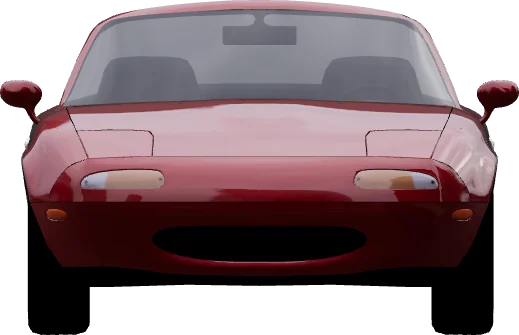
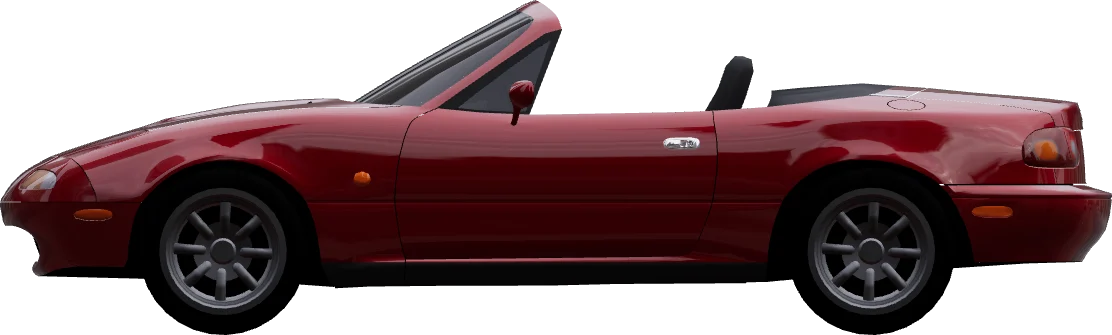
Mazda · Roadster

Mazda Roadster 1st generation (NA)

Years
1989–1998
Chassis
NA
Drivetrain
FR
Mazda Roadster 1st generation (NA)

Image: Ethan Llamas / CC BY-SA 4.0

Story

It began with a remark at Mazda's North American base: "if only there were a lightweight car like the MG". Its development keyword was "Jinba Ittai" (horse and rider as one), and it adopted FR, which had become rare in its class.

Stories

01

A thorny path

Advanced development was approved at a management meeting in February, and what awaited Hirai, appointed chief engineer, was a thorny path. The project came with the condition of using an overseas development contractor, but he judged that the prototype design drawings sent from the British contractor could not be used to develop a production car, argued for switching to in-house development, and his first job became ending the contract with that company. When the planning and design department refused to help, he appealed directly to Director Matsui of the technical research center and got four or five engineers, but they had no experience at all in layout work. Believing the only way to make up for the shortage of people was with computers, he introduced 3D CAD and had the computer draw the basic layout.

02

Drawings made after hours on a drafting board in the parking lot

The first Roadster began as a small in-house project short of both budget and people. Kijima, who was handling the suspensions of trucks and the RX-7, joined Toshihiko Hirai's team and drew plans on weekends and outside working hours on a drafting board he brought into the design division's parking lot. When the department responsible turned down improvements to drivetrain parts, he drew those plans himself too, though they were outside his specialty.
Takao Kijima

03

Assembling it himself to get the PPF through

To give shape to Jinba Ittai, Kijima proposed the power plant frame (PPF), which connects the rear of the transmission to the differential, and double wishbones front and rear. The PPF was a first for a Japanese car, but it met resistance from the plant, which built it on the same line as front-wheel-drive cars. Kijima went to the plant and showed that it could be put together in a form even an assembly amateur could assemble, which won over the shop floor.
Takao Kijima

Chassis

Width1,675 mmHeight1,235 mm
Wheelbase2,265 mmLength3,970 mm
Curb weight
940-1,030kg

Production plants

  1. Hiroshima Plant Ujina No.1

    Minami-ku, Hiroshima

US import eligibility

Earliest cars
Eligible since September 201425 years after sales began in September 1989
Last cars
Eligible since 202325 years after sales ended in 1998 (month not recorded)

Eligibility depends on each car's month of manufacture on its build plate, not on the sale dates shown here (NHTSA).

Japanese cars by US import year →

Engineers

Toshihiko Hirai

Toshihiko Hiraiuntil Jul. 1993

Hometown: Kudamatsu, Yamaguchi Prefecture

Development lead for the first-generation Roadster. He joined Toyo Kogyo, now Mazda, and became program manager for the first-generation Roadster in the product planning and development division. He also served as program manager for the AZ-1. He left Mazda to become a lecturer in the Department of Production Systems Engineering in the Faculty of Engineering at Oita University. He is an inductee of the Japan Automotive Hall of Fame.

Takao Kijima

Takao Kijimafrom Jul. 1993

Hometown: Yoshinogawa, Tokushima Prefecture

A former Mazda engineer. He became program manager for the first-generation Roadster when Toshihiko Hirai left, and afterwards served as program manager for the second- and third-generation Roadster and for the third-generation RX-7. He is a professor in the Faculty of Engineering at Sanyo-Onoda City University.

Shunji Tanaka

Shunji Tanaka

Chief designer of the first-generation Roadster. The face of the car was inspired by the koomote noh mask, and the lines along its flanks by the profile of the wakaonna noh mask. For his work on the product design he received an Invention Award from the Japan Institute of Invention and Innovation, for the design of a lightweight sports car.