
Tatsuo Hasegawa
ToyotaDevelopment lead
Created the first Corolla as an "80 points plus alpha" car, and left Toyota's chief engineers ten precepts
Timeline
- 1939
Tachikawa Aircraft Co., Ltd.
- 1946
Joined
Toyota Motor Corporation
- 1961
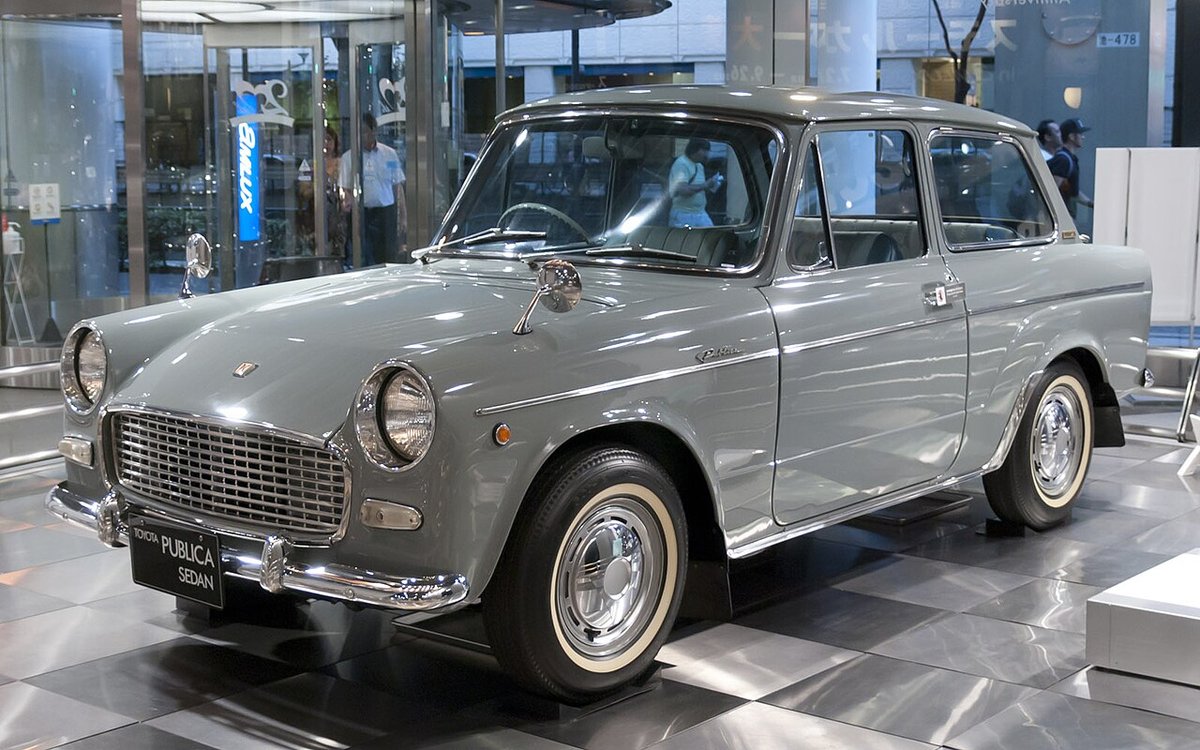 Publica 1st generation
1961–1969Development lead
- 1965
 Sports 800
1965–1969Development lead
A Car Never Meant to Be Sold
Development of the Sports 800 began at Kanto Auto Works on the premise of using the Publica's engine and chassis. The chief engineer was Tatsuo Hasegawa. According to Hasegawa, it was never built to be sold, and was nothing more than an experimental work done to pass the time between the end of Publica development and the start of the next car, the Corolla. Publica parts were used because company facilities could not be spared for a car with no plans for production. But when it was shown at the Tokyo Motor Show that year it drew an unexpected response, and at the request of the sales division it was put into production. It went on sale about three years later. Partly because Hasegawa strongly opposed it, arguing that Publica parts made for Japan could not withstand high-speed use on American roads, it was hardly exported, and cumulative sales had reached only 3,131 units by the end of sales.
- 1966
 Corolla 1st generation Corolla
1966–1970Development lead
The 80-point principle doesn't mean 80 points is enough
The Publica was fun to drive but lacking in the richness of a car. With the first Corolla, Hasegawa called his approach of not letting any subject, such as driving performance or safety, score below 80 points the "80-point principle." Any amount above 80 points was fine, but cost must not be raised more than necessary. On top of that, a car with 80 points in everything would have no character, so the concept became "80 points plus alpha," adding something that shines with new technology.
The plus alpha is sportiness
Hasegawa defined the first generation's plus alpha as sportiness. It used curved glass before the Corona or the Crown, and the engine had five bearings for quietness at high speed. In an era when much equipment was optional, it made rear lamps, two-speed wipers and an outside key lock on the left door standard.
- 1967
Director and Deputy General Manager, Product Planning Office
- 1968
 Sprinter (E15)
1968–1970Development lead
- 1970
 Celica 1st generation
1970–1977Development lead
- 1972
Managing Director and General Manager, Product Planning Office
- 1978
Senior Managing Director
Connections

- Superior
Hasegawa and other subordinates opposed the rear-hinged rear doors of the first-generation Crown on safety grounds, but Nakamura stubbornly pushed through their adoption.
- Subordinate
On the development of the first-generation Corolla, Sasaki helped chief engineer Hasegawa as his assistant, and later became chief engineer of the second- and third-generation Corolla.
Profile
From Tottori, Tottori Prefecture. Graduated from Tokyo Imperial University, Department of Aeronautics in 1939. Chief engineer of the first-generation Corolla. At Toyota he served in turn as chief engineer of the first-generation Toyoace, the first-generation Publica, the Toyota Sports 800 and the first-generation Corolla, and also served as chief engineer for development of the first-generation Celica and Carina. He was inducted into the Japan Automotive Hall of Fame.
Translated from Japanese sources.
Toyota engineers
- Hidetaka Takagi2000GT
- Jiro Kono2000GT
- Kameo UchiyamadaCrown
- Satoru Nozaki2000GT
- Takayuki OtsukaHilux
- Takeshi KomuroCrown
- Masao MorimotoHilux
- Shiro SasakiCorolla